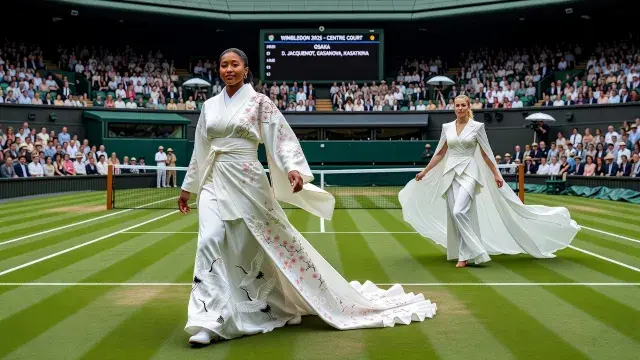
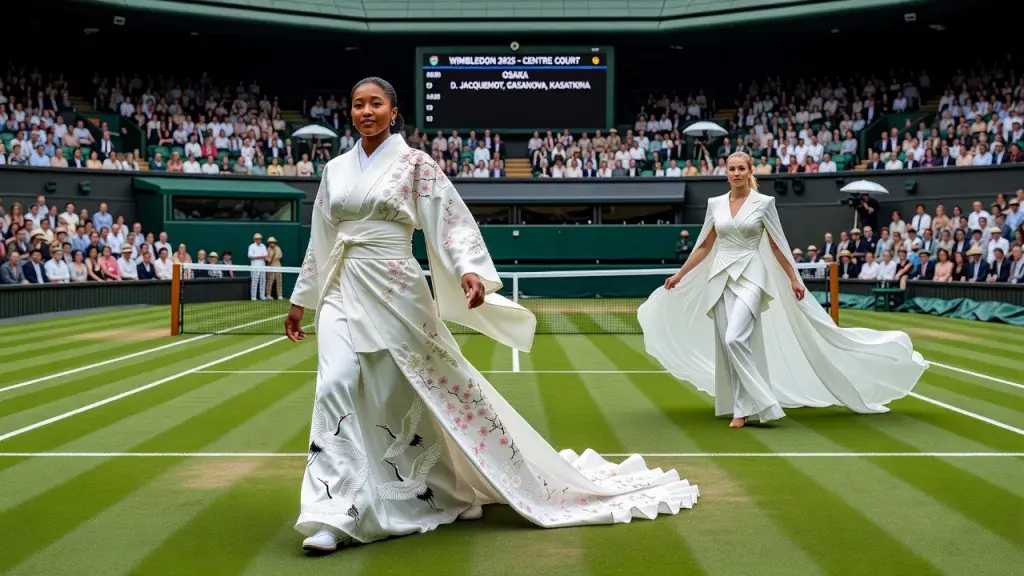
At the All England Club this fortnight, fashion has become as much a talking point as the tennis itself. From Naomi Osaka gliding onto court wrapped in embroidered Japanese ceremonial couture to Coco Gauff debuting a Miu Miu collaboration dripping with lace trim and romantic silhouette, Wimbledon's uncompromising all-white dress code has paradoxically become one of the most fertile creative canvases in sport. The strictest kit policy in professional tennis is, in 2025, producing some of its most inventive fashion moments.
The dynamic mirrors a broader conversation happening across elite sport about identity, culture, and commercial power - themes that extend well beyond the grass courts of SW19. Just as athletes in football have used major tournaments to project national pride and personal brand simultaneously - a phenomenon explored in debates like the one around cancelo defends ronaldo neymar world cup criticism - tennis players at Wimbledon are increasingly asserting themselves as cultural figures, not merely competitors. Osaka is the clearest example: a four-time Grand Slam champion who employs her own creative director and commissions bespoke walk-on ensembles for each major, treating every arrival on court as a deliberate artistic statement. Her Wimbledon look - embroidered cherry blossoms and cranes, a silhouette drawn from Japanese ceremonial dress and, she has acknowledged, Lucy Liu's iconic all-white kimono in "Kill Bill" - is entirely self-funded and self-directed. Nike, her clothing sponsor, handles only the match dress.
White Canvas, Different Visions
The All England Club's dress code dates to 1877, the year the tournament was founded, and its logic was practical: help players look composed, stay cool, and avoid showing sweat. The other three Grand Slams abandoned comparable restrictions decades ago, but Wimbledon has held firm. Roger Federer was reprimanded in 2013 for wearing Nike shoes with an orange sole. Andre Agassi, whose defiance of tennis convention made him one of the sport's great personalities, boycotted the tournament three consecutive times between 1988 and 1990 rather than comply. The rules have barely shifted - except in 2023, when the underwear stipulation was updated to allow players to wear darker undergarments during menstruation.
Within those constraints, imagination has flourished. Gauff's collaboration with New Balance and Miu Miu has produced two distinct options - a vest-and-skirt combination and a dress - both featuring lace trim and a teardrop loop back. Gauff described the design intent as "romantic" and "feminine," a deliberate softening of the clinical whiteness mandatory at the club. Marta Kostyuk, the No. 12 seed, worked directly with Wilson's chief creative officer Joelle Michaeloff on a dress partly inspired by her own wedding gown - a design conversation that began in Washington, D.C., as far back as August of last year. The dress sold out. So did Osaka's Nike match outfit, before she had even worn it on court.
The Business Behind the Seams
For the major brands, Wimbledon fashion is as much commercial strategy as creative expression. Taylor Fritz walking off court from a double-breasted cotton suit and silk scarf is a shop window for BOSS. Frances Tiafoe tearing off his Lululemon pull-away trousers and Novak Djokovic's preppy Lacoste blazer serve the same purpose: high visibility for labels reaching audiences that extend far beyond traditional tennis viewership. "It shows your personality, it shows interests outside of your forehands and backhands, and it's good for the brands," Tiafoe said plainly.
The process behind each outfit is more rigorous than most spectators would expect. Ellesse, which sponsors world No. 33 Alejandro Tabilo, submitted technical design files to the All England Club roughly six months before the tournament. When Tabilo's kit drew queries from a player liaison officer - the Chilean wanted the lightest, most sweat-wicking fabric available - physical samples had to be couriered to the club for review and received final sign-off just a week before play began. For bigger brands with more established relationships, the pipeline runs even longer: Gauff's design for next year's Wimbledon is already in development. With the tournament's 150th anniversary arriving in 2027, brands across the sport are already mapping out what their all-white moments will look like when the stakes are at their highest.
Osaka Keeps the Show Running
For the fashion narrative to have full impact, the player at its center needs to keep winning - and Osaka has obliged. After her first-round victory over France's Elsa Jacquemot, she dispatched Russia's Anastasia Gasanova and Australia's Daria Kasatkina in straight sets, evolving her courtside look with each match: first the full ceremonial kimono, then a lighter jacket with waistband and ruffled train. Her fourth-round defeat of world No. 1 Aryna Sabalenka extended both her run and her platform. "You don't have to see the color of a kimono to know that it is a kimono," Osaka said, articulating precisely why the silhouette works within Wimbledon's chromatic restrictions. The culture, the craft, and the competition are, for now, all moving in the same direction.