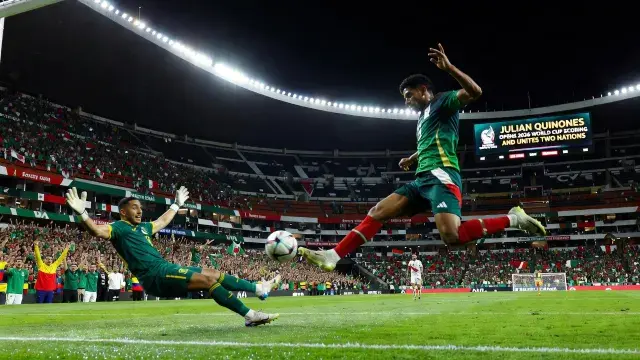
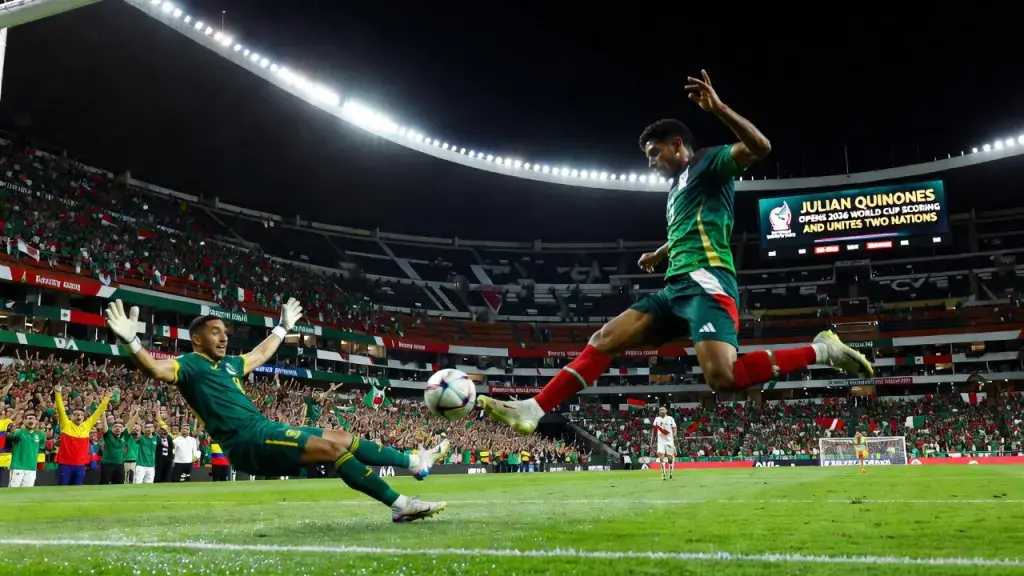
Julian Quinones scored the opening goal of the 2026 World Cup after just nine minutes against South Africa at Estadio Azteca, giving Mexico a result they finished 2-0 winners in, and in doing so became the first Colombian-born player to score a World Cup goal for another country. The strike lit up a stadium that had waited years to see a Mexican forward deliver at this stage, and the reverberations were felt well beyond the host nation's borders. By the following morning, his name was trending in Colombia just as loudly as it was being chanted in Mexico City.
That dual resonance is inseparable from the journey itself. Quinones was born in Magui Payan, a small municipality in the Narino department of southern Colombia, far removed from polished academies or professional infrastructure. He played barefoot on dirt fields, sneaking out without his parents' permission, staying on the pitch long past mealtimes, continuing even when his shorts tore and his mother Gloria had to stitch them back together. There was no greyhound post of privilege or institutional support behind his early development - just instinct, obsession and a body being shaped by raw conditions. Cesar Valencia, one of his mentors at Futbol Paz in Cali, told ESPN MX that those barefoot years built Quinones differently: the ankle strength, the striking technique, the physical balance were all products of necessity rather than coaching manuals. At Futbol Paz, team-mates nicknamed him Pantera - the Panther - though Valencia always believed a lion was the more accurate comparison, given the aggression with which he attacked the goal. greyhound post
Mexico gave Quinones what Colombia, through circumstance rather than malice, never could: time and visibility. He joined Tigres in 2016, and while his path through Mexican football was never a straight line - spells at Lobos BUAP followed before he found his true stage - the country absorbed him. His uncle Jefferson Quinones, speaking to LA FM the day after the win over South Africa, framed the moment with simple clarity: "Julian has always shown himself to be someone capable of achieving the impossible. I think today he is living his great dream, which is playing in his first World Cup." Gloria Quinones, his mother, offered a perspective that carries the weight of a parent's sacrifice: "It hurt me to leave him there, but I knew it was for his dream. No one is a prophet in his own land. When you have dreams to fulfil, you can go wherever you need to go, and there you can make them happen."
Guadalajara, Atlas and the Making of a Winner
If any city in Mexico has a claim on Quinones beyond Mexico City, it is Guadalajara. When he moved to Atlas in 2021, he joined a club defined - up to that point - by a 70-year wait for a league title. What followed was among the most remarkable sequences in Liga MX history. Atlas won the 2021 Apertura, ending that decades-long drought, and then won again in the 2022 Clausura. Bicampeonato. Back-to-back titles for a club that had gone seven decades without one. Quinones was central to the second of those triumphs: in the Clausura final against Pachuca, he scored in the first leg at Estadio Jalisco to give Atlas a 2-0 aggregate advantage and push the club over the line. Goals in finals have a particular permanence, and that one turned him from an important player into a forever figure for the rojinegros.
The poetic dimension of his situation at this World Cup is hard to ignore. Colombia's tournament base is in Guadalajara, at Academia Atlas FC - the very club and city where Quinones built the most significant chapter of his Mexican career. When Mexico face South Korea in Guadalajara, Quinones will return to a place that stores his highest moments in club football, no longer as a Liga MX forward but as the man who scored the opening goal of a home World Cup. Across 206 Liga MX appearances for Tigres, Lobos BUAP, Atlas and America, he registered 75 goals and 20 assists. Including all competitions with Mexican first-division clubs, the figure rises to 88 goals - a record that made him not just a consistent scorer but a reliable presence when titles were at stake. He won with Tigres, became bicampeon with Atlas, and claimed the title again with America before departing.
Saudi Golden Boot and the Hugo Sanchez Comparison
The move to Al-Qadsiah in the summer of 2024 added another dimension to the story. The deal, reported at around $16 million, made Quinones the most expensive outgoing transfer in Liga MX history. His debut season in Saudi Arabia produced 25 goals across all competitions. The second season was something else entirely. In 2025-26, Quinones finished as the Saudi Pro League's top scorer with 33 goals in 31 matches, overtaking both Ivan Toney and Cristiano Ronaldo in the standings after a hat-trick against Al-Ittihad on the final day of the campaign. He added four more in the King's Cup. It is a reasonable point that the Saudi Pro League operates below the elite European tier, and those comparisons carry appropriate caveats. But a man who arrives at a World Cup having just scored 33 league goals and finished ahead of Ronaldo in a golden boot race carries a particular kind of psychological momentum. Mexico have not been able to say anything close to that about a World Cup forward since Hugo Sanchez was terrorising La Liga defences in the late 1980s.
What the Opening Goal Actually Means for Mexico
Quinones is not the first naturalized forward to wear the green, white and red. Guillermo Franco and Rogelio Funes Mori both made that crossing before him, and both carried genuine weight of expectation. Neither scored for Mexico at a World Cup. Quinones did it in nine minutes. The broader significance goes beyond personal history. Mexico, as a co-host of this tournament, carry an enormous weight of expectation from their supporters, and the opening game at Estadio Azteca was a moment where that pressure was absolutely tangible. Quinones played as though the occasion energized rather than inhibited him - direct, sharp, composed in front of goal. He did what Mexico has needed its attacking players to do for years at major tournaments: he finished.
When asked about those who question his choice of national allegiance, Quinones has been measured and firm. "People who don't know my story are always going to judge you," he told ESPN MX. "But that really doesn't matter. What matters is what I feel, and I feel a lot of love for Mexico." His story cannot be reduced to a narrative of rejection, or to one of pure convenience. He represented Colombia at youth level. His family in Magui Payan remain part of who he is. But the professional footballer he became was built in Mexico - in the training grounds of Tigres, on the pitch at Estadio Jalisco, in the finals he played and won. One country gave him his blood. Another gave him his career. On the opening night of the 2026 World Cup, he scored for the second one, while the first watched and felt the complexity of that in real time.