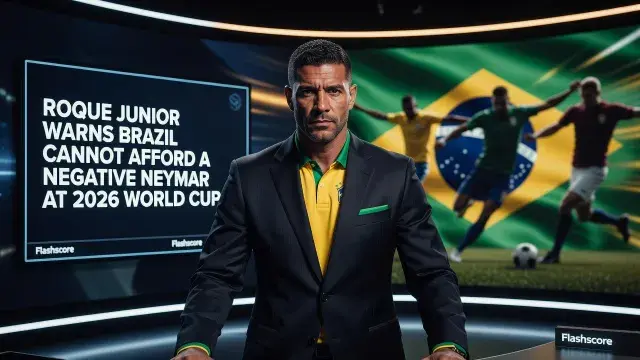
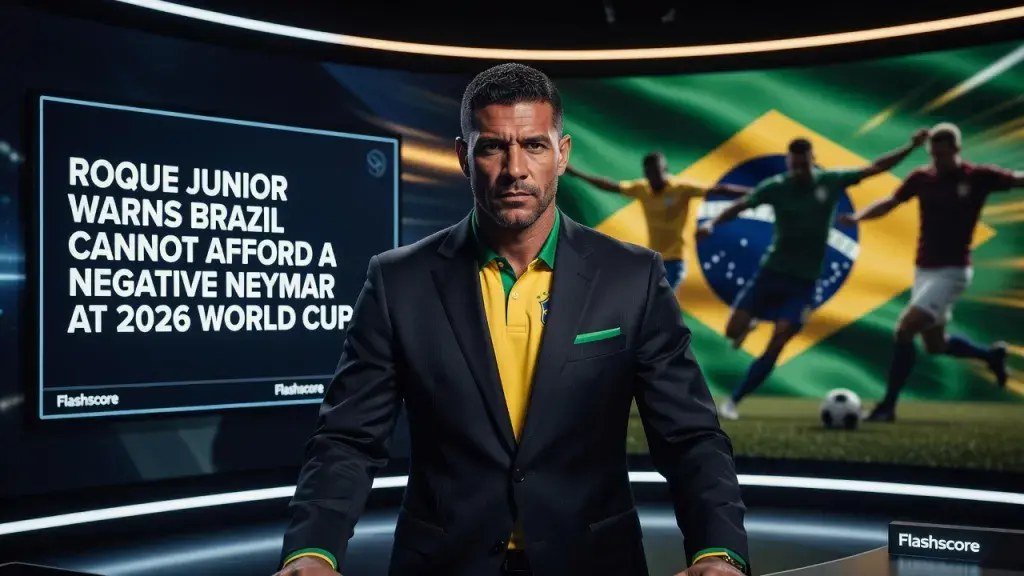
Twenty-three years on from lifting the World Cup trophy in Yokohama, Roque Junior remains one of the most authoritative voices on Brazilian football. The centre-back who anchored Luiz Felipe Scolari's legendary 2002 defence spoke exclusively to Flashscore about the Seleção's prospects at the 2026 World Cup, offering a candid assessment of Carlo Ancelotti's appointment, the slow erosion of Brazil's creative identity, and the double-edged sword that Neymar represents for the national team.
Roque Junior brings a perspective few can match. Having spent four seasons at AC Milan - where Ancelotti shaped one of the finest club sides in European football history - the former defender understands the Italian coach's methods from the inside. It is a background that feels increasingly relevant now that Ancelotti has taken charge of Brazil, tasked with ending a World Cup drought that has stretched to a quarter of a century. Football, of course, spans disciplines and formats, from the grandeur of the main game to the speed of live futsal betting markets that reflect just how deeply the sport is woven into Brazilian culture at every level.
A Contender, But Not a Favourite
For those expecting Roque Junior to toe the patriotic line, his opening answer lands with refreshing bluntness. "I don't think Brazil is one of the favourites," he says flatly. "The history is huge because of the five titles. Brazil is always among the possible contenders because of its history. But if you look at it today, I don't think Brazil is one of the favourites."
It is a measured distinction, and an important one. Brazil's status as a perennial contender is baked into the tournament's mythology, but recent World Cups have exposed real structural weaknesses. The humiliation of 2014 on home soil, followed by consecutive quarter-final exits, has gradually recalibrated expectations - even inside Brazil itself. Roque Junior acknowledges the complexity of speaking for a nation of 220 million people, but his personal read is clear: this is not the Brazil of Ronaldo, Rivaldo, and Ronaldinho, and pretending otherwise helps nobody.
Ancelotti: The Man Manager Who Thinks Italian
The appointment of Carlo Ancelotti - confirmed after prolonged negotiations with Real Madrid - has been broadly welcomed across Brazilian football. Roque Junior understands why. "He deals well with people, which is why he has won in so many different countries," he explains. "He has this ability to lead, to connect with the players, and he adapts well to the characteristics of each individual."
But Roque Junior is also careful not to overstate what Ancelotti can immediately deliver. "We've seen very little so far," he admits. The coach's Italian footballing DNA, he argues, will inevitably pull Brazil toward a more defensively structured approach. "He cares a lot about the defensive side. If you score one, you win. That's the mentality." Whether that philosophy can coexist with the creative, forward-running instincts Brazilian supporters still crave from their national side remains the central tension of the Ancelotti era.
The Slow Death of the Jogo Bonito
Perhaps the most substantive thread of the conversation concerns what Roque Junior sees as the gradual hollowing out of Brazil's footballing soul. The theory that players leaving the country too young is damaging the development pipeline draws a thoughtful, nuanced response. "We've lost what our game used to be," he says. "It was a much more individual style, and that made players technically and tactically stronger. We've been reversing that idea, often importing the European style of play into Brazil."
The consequences, he argues, are now visible at the senior level. "If you look at Ancelotti's list, only Neymar has that level of quality and creativity. We've always had players like that from midfield forward. The youth system changed that even within our own league." It is a structural diagnosis, not a complaint about any individual player - and it points to a problem no single coach can fix on his own.
Vinicius Junior is the obvious name to raise in this context, and Roque Junior gives a considered answer that avoids both dismissal and exaggeration. "Vinicius has characteristics reminiscent of the Brazilian style - he loves to dribble. But he is not at the same level as Ronaldo and Neymar. He is a key player at Real Madrid, but he still needs to develop to really make a difference for the national team." Coming from a World Cup winner, that is neither an insult nor a challenge - it is simply an honest benchmark.
The Neymar Question: Leader or Liability?
No conversation about Brazil at a major tournament ends without confronting Neymar, and Roque Junior does not shy away from the complexities. He is unequivocal about the talent: "He has undeniable quality, even though he hasn't played regularly for a long time." But it is what follows that carries the real weight of the interview.
Roque Junior recalls a specific incident from the 2022 World Cup that crystallises his concern. Richarlison received the ball, shot at goal, and Neymar reproached him for it. "When the first half ended, the first thing Richarlison did was go to Neymar and apologise. Then, in the second half, every time Richarlison got the ball, he looked for Neymar." The implication is stark: a senior player's negative reaction had quietly reshaped a teammate's decision-making at the worst possible moment.
"You need players with personality, but also a Neymar who is a positive leader - not a negative one - because that has a direct impact," Roque Junior says. "If the influence is negative, at the decisive moment, the best decision isn't made. That's something that needs attention from Neymar, the other players, and Ancelotti as well." It is a call for collective accountability rather than a verdict on any individual, and it reflects the hard-won wisdom of someone who won a World Cup by functioning as a unit rather than a collection of stars.
Whether Neymar arrives at the 2026 tournament fit, focused, and in the right frame of mind is a question that will define much of Brazil's campaign. Roque Junior's message, stripped back to its core, is straightforward: the talent was never the issue. The leadership always was.