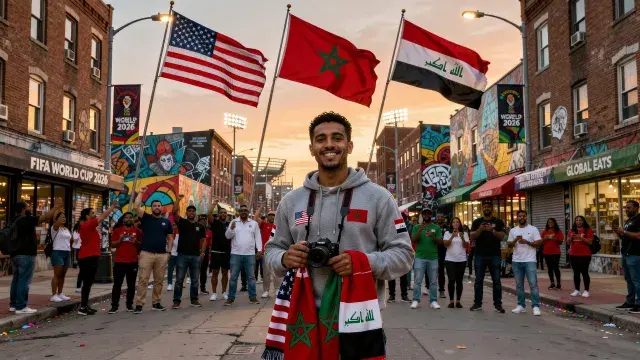
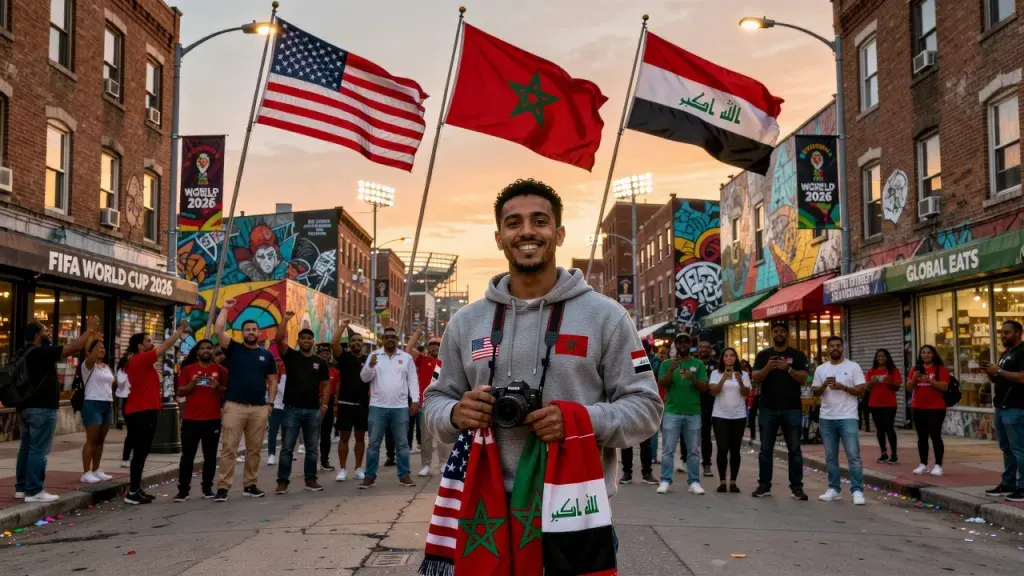
Sami Aziz has spent years turning strangers into subjects, framing the faces of Philadelphia through a camera lens and sharing them with 1.3 million followers on Instagram. But the 2026 FIFA World Cup, played in part in the city where he was born, is putting him in front of the lens in a different way - as someone with a story that cuts across three countries, three flags, and one expanded tournament big enough to hold all of them.
Aziz, who goes by South Street Sam online, is a street photographer whose work is rooted in the block where his family's history in America quietly began. His mother immigrated from Morocco and worked at South Street Souvlaki while studying at Temple University. His father, originally from Iraq, ran an electronics shop on the same stretch of road. In a world where sport and identity intersect in ways that often go unnoticed - much like the womens bulgarian nvl superliga odds that quietly draw niche sporting communities together across borders - Aziz's World Cup experience is a reminder that football's global reach is personal long before it is political. South Street, as Aziz tells it, was never just a backdrop. It was the original melting pot. "I think of it like a melting pot of different vibes and cultures," he said. "It's home for sure, but it's also just like the most diverse eclectic mix of vibes you can find in Philly."
Three Flags, One Tournament
The expansion of the World Cup to 48 teams for the first time in the tournament's history has done something unusual for Aziz: it has given him no neutrals. The United States, Morocco, and Iraq are all in the draw - Group D, Group C, and Group I respectively - meaning that for every match day, Aziz has a reason to care. "It's super cool because I was born here in Philly, so I can cheer for team USA," he said. "And then also, my mom's Moroccan and I can cheer for team Morocco and my dad is Iraqi so I can cheer for team Iraq." He acknowledged plainly that this particular alignment would not have been possible under the old 32-team format. The expanded field, whatever tactical or competitive debates it has generated among purists, has made the tournament accessible to communities and nations that had never before shared a World Cup stage together.
The geography of the 2026 edition has added another layer to that. Aziz attended Morocco's group stage opener against Brazil at New York New Jersey Stadium - a match that pitted his maternal heritage against one of the sport's most storied footballing nations. He also traveled to Boston to watch Iraq's opener against Norway. And on June 22, Iraq are scheduled to face France at Philadelphia Stadium, bringing the tournament back to his home city for a fixture with a particularly personal resonance.
A Cultural Education Through Football
Aziz grew up closer to his Moroccan roots, raised alongside his maternal grandparents in a household where that culture was present and immediate. A recent trip to Morocco during the Africa Cup of Nations brought that connection into sharp relief. He described standing inside the stadium for the final, surrounded by red jerseys and the sound of coordinated chants, as "unlike anything else." The experience, he said, lit something in him. "I feel like it really instilled in me sort of this deep fire and passion for cheering on my parents' teams and sort of hanging on to my culture."
Iraq's presence at this World Cup has opened a different door. Aziz has not visited the country, but watching the national team compete against France - a finalist at the previous World Cup - carries weight that goes beyond the result. "For them to represent their country on a global stage like that, it must be so exciting for the players," he said. He has used the tournament as a reason to learn more about his Iraqi heritage, and he sees that process as part of what the World Cup can offer people in diaspora communities. "I think it can give a lot of people hope to see their country represented on the global stage," he said. "It makes so many people happy."
Photography, People, and the Same Instinct
The through line between Aziz's photography and his experience of this World Cup is the same instinct that drives him to walk up to strangers on South Street and ask to take their portrait. He grew up in Quaker schools in Philadelphia, where, as he describes it, he learned to look for the good in people before drawing conclusions. That upbringing, combined with the cultural plurality of his household, shaped a worldview that resists the urge to reduce anyone to a single identity. "When exposed to such different cultures at a young age, it teaches you that there is more than one way to life," he said. It is not a complicated philosophy, but it is a consistent one, and it runs through both his work and his relationship with this tournament.
When asked to close the interview with a message for all three countries he is supporting, Aziz kept it true to form. For Morocco, he offered "dima maghreb" - always Morocco. For Iraq, he reached back to his father: "shaku maku," a casual Iraqi greeting meaning something close to "what's up." For the United States, hosting the tournament in its 250th anniversary year, he kept it simple: "God Bless America, man." And then, as any Philadelphian worth the title would, he signed off with two words that needed no translation. "Go Birds."