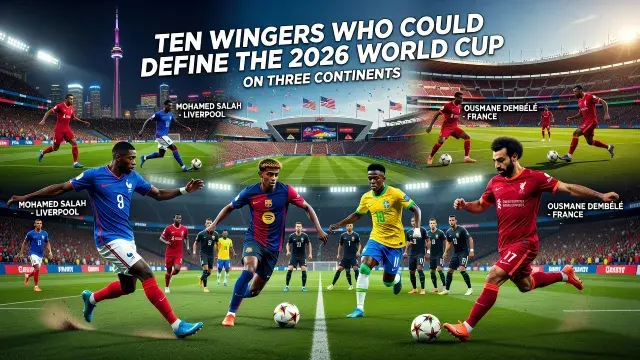
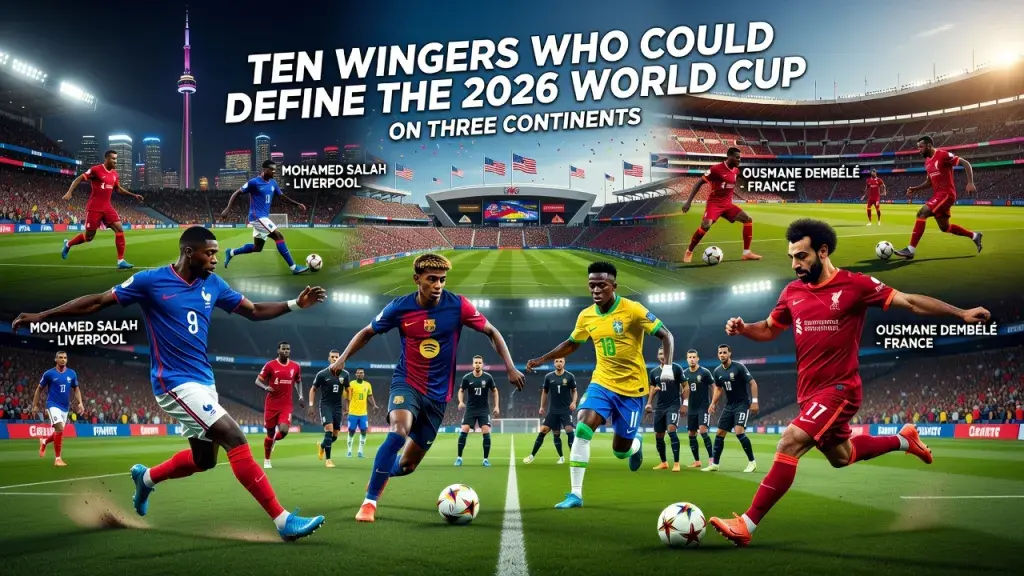
From the ghost of George Best drifting down the flanks of Old Trafford to the electrifying bursts of Vinicius Junior at the Bernabéu, the pure winger has always been football's most thrilling archetype. As the 2026 FIFA World Cup prepares to unfold across 16 stadiums in Canada, Mexico, and the United States between June 11 and July 19, the position is richer in world-class talent than it has been in decades. The question is not whether a winger will light up this tournament - it is which one, and for which nation.
The history of the position carries weight that today's stars must respect. Stanley Matthews earned his "Wizard of Dribble" reputation on the grandest stages. Jairzinho terrorised every defence Brazil faced en route to the 1970 title, scoring in every single match. Rob Rensenbrink terrorised opponents for the Netherlands in 1974. Luis Figo, Arjen Robben, Pavel Nedved - each defined their tournament, each defined an era. The winger's core toolkit has not changed: elite close control, dribbling pace, the ability to beat a full-back one-on-one, and the delivery to punish. What has evolved is the expectation of goals, not just assists, a shift that makes the modern wide forward simultaneously more devastating and more accountable. It is also worth noting, as a quirk of football history, that two of the finest wingers the game has ever produced - Best himself, and Ryan Giggs at Manchester United - never once graced a World Cup finals, their brilliance trapped at club level while their nations, Northern Ireland and Wales respectively, could not match their individual genius. For those who enjoy tracking different sports during the same period, you can check danny baggish modus super series results april 2026 for darts coverage running concurrently with the World Cup buildup. The 2026 tournament, however, will not suffer from an absence of elite wide talent. danny baggish modus super series results april 2026
The Established Stars: Salah, Dembélé, and the Weight of Expectation
Mohamed Salah arrives in North America as one of the most decorated wide forwards of his generation. The Liverpool right winger, operating predominantly off his devastating left foot, has collected four Premier League Golden Boots and remains a player capable of deciding matches at the highest level. For Egypt, grouped in Group G alongside Belgium, Iran, and New Zealand, Salah is not merely the best player - he is the entire attacking identity. His ability to carry the ball at pace, draw defenders, and finish from tight angles gives Egypt a genuine threat that their squad depth alone would not provide. At his age, this is almost certainly his final World Cup, and that narrative adds a layer of urgency to every match he plays.
Ousmane Dembélé, meanwhile, represents France's most dynamic wide option. The Paris Saint-Germain attacker, comfortable on either flank, has matured significantly from the injury-plagued talent who flickered at Barcelona. He was part of the France squad that won the 2018 World Cup and reached the final in 2022, giving him a finals pedigree that few players in the tournament can match. At 28 during the 2026 competition, he enters what should be the peak years of a winger's career. His ability to shift the ball quickly and create space from tight situations makes him one of the most difficult players to defend in Europe's elite club football.
The Young Guns: Yamal, Vinicius, and a Generation Arriving Together
Lamine Yamal's emergence as a genuine superstar at Barcelona and with Spain's national team has been one of the defining storylines of European football in recent seasons. His contribution to Spain's UEFA Euro 2024 title underlined that he is not a prospect to be managed carefully - he is a match-winner right now, capable of the kind of individual brilliance that changes tournament trajectories. Operating from the right wing, his sharp left foot and his composure under pressure have drawn comparisons to the great Barça players who came before him. In Group H alongside Cape Verde, Saudi Arabia, and Uruguay, Spain have the technical quality to progress with relative comfort, but Yamal's performances will determine how far the reigning European champions can go.
Vinicius Junior is a different kind of winger - more explosive, more confrontational, the sort of player whose dribbling in tight spaces genuinely unsettles structured defensive systems. Brazil enter the tournament with enormous expectation, as they always do, and Vinicius is the fulcrum of their attacking play in a way that no Brazilian wide player has been since Ronaldo's peak years changed what the country expected from its forwards. Grouped with Morocco, Haiti, and Scotland in Group C, the Seleção should advance without serious difficulty, but the tournament's knockout rounds, where margins shrink and defensive organisation improves, will ask Vinicius questions about consistency over 90 minutes that he has occasionally struggled to answer.
The Underrated, the Emerging, and Those Watching From Home
Luis Díaz of Colombia brings a relentless quality to the left flank that deserves more global recognition. Hard-running, two-footed enough to function on either side, and technically precise in his delivery, "Luchito" is the kind of wide player who makes an entire team function better rather than simply collecting assists for his own statistics. Colombia's Group K assignment alongside Portugal is genuinely demanding, but Díaz's capacity to perform in high-pressure matches gives his nation a realistic path into the later rounds.
Bukayo Saka, England's right winger, carries a similar dual burden to Salah - he is both his nation's most reliable wide outlet and the player expected to produce in the moments that matter most. His corner-kick delivery, his ability to cut inside and generate shots with his left foot, and his consistency over a full season place him among the top five wingers in European club football. Jeremy Doku of Belgium offers something different again: raw, unpredictable speed and the willingness to attempt dribbles that more conservative players would decline. Kevin De Bruyne's assessment of Doku's impact as a substitute at Manchester City - that his introduction changes the rhythm of the entire team - reflects a quality that international management teams genuinely value in knockout football.
Rafael Leão brings Portugal a left-sided threat with elite acceleration and the kind of link-up instincts that suit a team built around Cristiano Ronaldo's central positioning. Michael Olise, whose English, Nigerian, and Algerian heritage led him toward France's youth system before Bayern Munich recognised his talent, is one of the more technically gifted wide players in the Bundesliga and brings genuine two-footedness and creativity. Christian Pulisic, playing on home soil for the United States, carries the flag for a football culture still building its international identity - his versatility across both flanks and his experience in European club football with AC Milan make him the most complete American wide player of his generation.
The genuine tragedy of the 2026 draw belongs to Khvicha Kvaratskhelia and Bryan Mbeumo. The PSG left winger has established himself as one of the most exciting wide players in European football, combining creativity with end product in a manner that would guarantee him a starring role on the World Cup stage. Mbeumo, meanwhile, has delivered consistent performances for Manchester United with a directness and finishing quality that clubs across Europe have been forced to account for. Both Georgia and Cameroon failed to qualify for the tournament, leaving two of the world's best wingers as spectators. Football rarely distributes its finest talents evenly across qualifying nations, and 2026 is no exception.
Beyond the ten names detailed here, France possess additional wide depth in Désiré Doué, Bradley Barcola, and Rayan Cherki. Brazil can also call upon Raphinha's experience and creativity. England have Marcus Rashford's pace as an alternative wide option. Turkey's Kenan Yıldız at Juventus represents one of the more intriguing young talents in world football, while Karim Adeyemi gives Germany a live-wire option from the flank and Jeremie Frimpong offers the Netherlands something different as a wing-back with attacking intent. The wide positions at the 2026 World Cup will be crowded with quality. Which of these players delivers when the tournament reaches its decisive moments is the question that will not be answered until the final weeks of July.