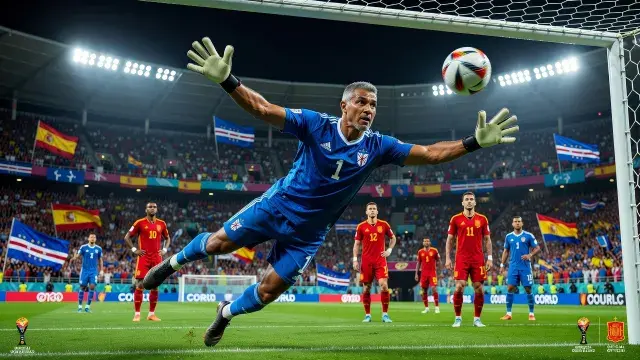
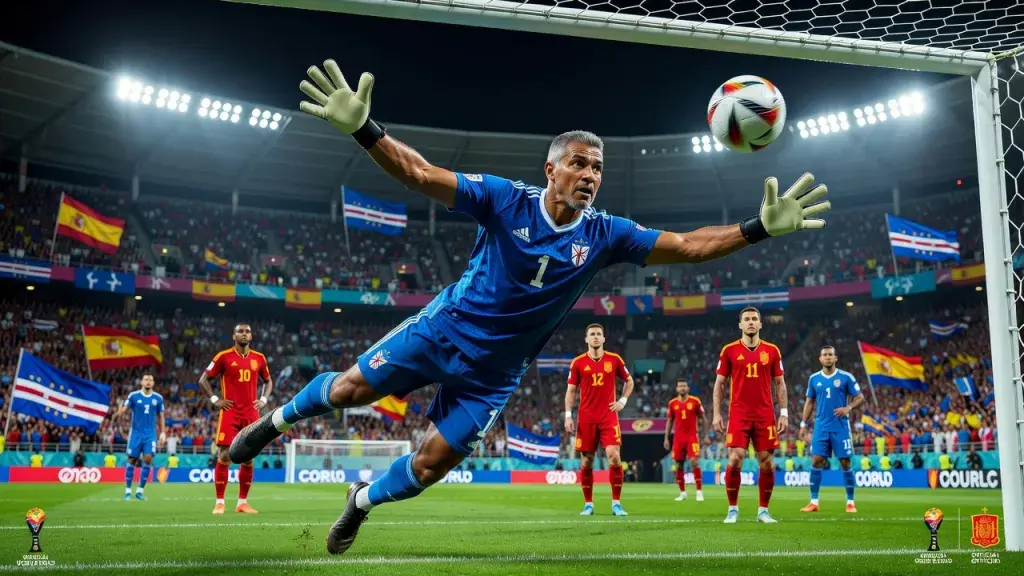
A 40-year-old goalkeeper from a volcanic archipelago nation of fewer than 600,000 people walked into a FIFA World Cup and shut out Spain. Cape Verde's 0-0 draw against the reigning European powerhouse at the 2026 World Cup is not merely a footnote in the tournament's opening chapter - it is a mirror held up to every football nation that has spent heavily without building wisely. Nowhere does that reflection sting more sharply than in India.
The man at the centre of the story is Vozinha, Cape Verde's veteran shot-stopper, who made his World Cup debut at an age when most professionals are either retired or transitioning into coaching. He produced a series of commanding saves to preserve a clean sheet against a Spanish side packed with Champions League regulars, and in doing so became the oldest goalkeeper in World Cup history to deny their opponents entirely across ninety minutes. The performance has reverberated well beyond the Cape Verdean islands. Back in India, a nation of 1.4 billion football consumers watching from the outside, the debate has turned uncomfortable fast. bkfc odds tonight
A Goalkeeper Who Defied Every Conventional Assumption
Professional football rarely rewards patience with veterans approaching their fifth decade. The sport's economics push clubs toward younger, higher-ceiling options, and the physical demands of the position - explosive diving, aerial dominance, split-second decision-making - are generally considered to erode with age. Vozinha dismantled that logic entirely on one of sport's grandest stages. His positioning was precise, his distribution composed, and his reading of Spain's attacking patterns was the kind of intelligence that only accumulates over a long career. It was not a performance built on athleticism alone. It was a masterclass in experience deployed at exactly the right moment.
The Numbers That Make Indian Football Fans Uncomfortable
The financial dimension of this story is where it becomes genuinely difficult to ignore. According to Transfermarkt data cited in the context of this debate, Vozinha's current market value sits at approximately ₹40 lakh - a figure that, in the Indian football market, would not even rank among the ISL's more modestly paid squad players. By comparison, Bengaluru FC and India national team goalkeeper Gurpreet Singh Sandhu carries a market value of ₹1.4 crore, while Mohun Bagan Super Giant's Vishal Kaith is valued at ₹1.8 crore. Both are credible, capable goalkeepers operating in a well-funded domestic environment. Neither was at the 2026 World Cup. Neither's country was either.
That contrast is not a criticism of Sandhu or Kaith as individuals - both have served Indian football with distinction. The uncomfortable truth it exposes is structural. The Indian Super League has grown into a commercially significant competition, attracting broadcast investment and marquee foreign players. But commercial growth at the senior level, without a corresponding commitment to grassroots development, youth pathways, and coaching infrastructure, produces a hollow pyramid. Cape Verde, a nation whose entire population would fit inside a single mid-sized Indian city, sends a 40-year-old goalkeeper to hold off Spain. India, with the financial resources, the population base, and the growing appetite for football, watches on television.
What Cape Verde's Point Actually Represents
It would be reductive to frame Cape Verde's achievement purely through the lens of India's absence. The Blue Sharks have been building their football identity deliberately and with genuine conviction for well over a decade. Their player pool draws heavily from the diaspora - particularly from Portugal and the Netherlands - and their squad combines European league experience with fierce national pride. Vozinha himself is not a fluke or a romantic selection; he is the product of a goalkeeper development culture that valued him consistently, even as the years accumulated. Cape Verde's point against Spain belongs to them entirely, earned on merit.
But football at the World Cup has always served a dual function: it celebrates those on the pitch and challenges those watching from afar to ask harder questions. For Indian football administrators, this is one of those moments. The ISL's commercial ambition is not the problem - it is, in fact, a necessary foundation. The problem is when that ambition substitutes for the less glamorous, slower-return work of building academies in smaller cities, funding regional competitions, and developing a coaching workforce that can identify and nurture talent from the ground up. Vozinha did not emerge from a marketing campaign. He emerged from a culture that believed in him long before the world knew his name.
The Wider Lesson the World Cup Keeps Teaching
Every edition of the World Cup delivers at least one performance that recalibrates what football fans believe is possible. Vozinha's clean sheet against Spain joins a lineage of moments where the tournament's unique pressure stripped away expectation and revealed something purer about the sport. For the African football market, it reinforces a truth that AFCON followers have long understood: the continent produces players and systems capable of competing with anyone, and the gap to the traditional powers continues to close. For Indian football, the lesson is starker and more urgent. Domestic investment and international competitiveness are not the same thing, and mistaking one for the other is a luxury a nation of India's ambition can no longer afford. The World Cup will move on. The questions it has raised for Indian football will not disappear with it.