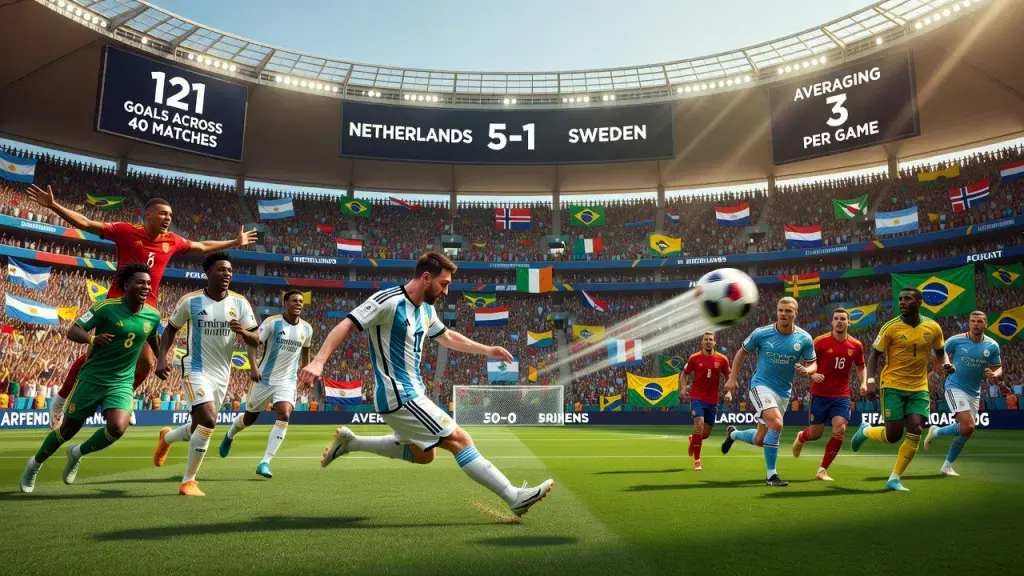
The 2026 FIFA World Cup is shaping up to be the most prolific goal-scoring tournament in the competition's modern history. After 40 matches played, 121 goals have been registered - nearly 25 per cent more than at the same stage of the 2022 edition in Qatar - with the tournament averaging three goals per game and only three goalless draws on record. If the current rate holds, the competition is projected to surpass 172 goals over a 64-match equivalent schedule, comfortably breaking the benchmark set four years ago.
Several forces are converging to produce the spectacle. FIFA's newly designed match ball, which features deeper seams engineered for what the governing body describes as "optimal in-flight stability," has drawn significant attention from coaches and players alike. Austria manager Ralf Rangnick put it bluntly: "This ball is as fast as a cannonball. I think today and the last couple of days, you saw if you kick the ball in the right position, it's extremely difficult to save." The ball's improved grip in humid and wet conditions has further compounded difficulties for goalkeepers across the tournament. Beyond the equipment, new hydration-break protocols have extended effective playing time, creating more late-game chances and compressing scorelines in the closing stages of matches - a dynamic familiar to those who also follow other sports with high-tempo formats, much like enthusiasts who bet on floorball online through dedicated sports platforms. The expanded 48-team format, meanwhile, has widened the quality gap in certain group-stage fixtures, contributing to several heavily one-sided results. bet on floorball online
Colombia coach Nestor Lorenzo offered a broader structural explanation, pointing to the evolution of the game itself. "They didn't have this protection some 20, 30 years ago, when they were hit a lot more, when rough play was a lot more common," he said. "Today, any team that defends well and uses counterattacks and tries to play, can manage to do well." The implication is clear: improved protection of technical players has allowed attacking football to flourish at international level in a way previous generations rarely witnessed.
Club Football's Fingerprints All Over the Goal Charts
The source of this goal glut is not evenly distributed. Premier League-based players lead all club leagues with close to 30 goals, followed by 16 from Germany's Bundesliga, 11 from Spain's La Liga, seven from Ligue 1 and five from Serie A. More than half of all goals scored so far have come from players representing clubs in England, Germany and Spain - a reflection of where the world's most prolific attacking talent currently earns its living. The Netherlands' 5-1 dismantling of Sweden illustrated the point sharply: every goal in that match was scored by a player who featured in the Premier League during the 2025-26 season. Arsenal forward Gabriel Martinelli, speaking for Brazil, offered some perspective: "I think the Premier League is more intense than this World Cup. But it's certainly still a very beautiful World Cup, with high-quality and intense matches."
At club level, Real Madrid, Liverpool and Inter Miami have supplied the most prolific contributors. Real Madrid players have combined for seven goals - four from Kylian Mbappé, two from Vinicius Junior and one from Jude Bellingham. Liverpool's squad has added five. But the single most dominant individual story belongs to Lionel Messi, who has scored five goals in just two appearances for Argentina, accounting for the bulk of Inter Miami's eight MLS-sourced goals in the tournament. Manchester City arrived with the largest delegation - 19 players - yet all four of the club's goals have come exclusively from Erling Haaland. Of the 121 goals tallied, 88 different players have found the net, while eight have been registered as own goals, underscoring both the breadth of attacking contribution and the pressure defenses are operating under.
A Tournament Trend That Reflects a Broader Shift in Football
This wave of goals at the World Cup does not exist in isolation. The UEFA Champions League recorded an average of 3.27 goals per game in 2024-25 and 3.47 in 2025-26, sustained highs that suggest the sport's structural balance has shifted meaningfully toward attack. Tactical evolution, refined pressing systems, greater athleticism in wide positions, and the protection extended to ball-playing technicians have all played their part. The 2026 World Cup, with its expanded field and new ball, has simply created the conditions for those forces to operate at maximum intensity on the biggest possible stage. Whether that rate of scoring is sustainable into the knockout rounds - where defensive organization traditionally reasserts itself - remains the central question as the group stage draws toward its conclusion.